Introduction to Barcodes and Barcode Technology
SageData is based in Ottawa, Ontario, Canada
Definition
The term "barcode" is usually used to refer to a symbol that represents data in a form that is easily read by a computer.
Barcode types
Barcodes come in a variety of formats. Most barcodes in use today are either linear (or 1D)
or 2-dimensional (2D).
1D barcodes appear as a series of vertical lines, and both the lines and
the
spaces between them vary in width.
2D barcodes appear as a series of black squares or dots on a
white
background.
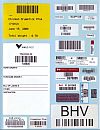 On the right there are some examples of barcoded labels. Click
on the image for an expanded view.
On the right there are some examples of barcoded labels. Click
on the image for an expanded view.
Click here to answer the question Should I
use 1D
or 2D
barcodes?
1D Barcodes
1D barcodes come in a variety of symbologies. These symbologies work in the same way as fonts in a computer program. Although using different fonts may change the appearance of a letter, the underlying information is not affected. So with barcodes, using a different symbology will change the appearance of a barcode, but have no affect on the information contained in the barcode.
Symbologies
Common symbologies used for 1D labels include code 39, code 128, UPC and EAN. Each has their own strengths. Code 39 is an older and simpler code, 128 provides the ability to code more characters, UPC is specifically used in retailing, and EAN is coming in as a more common standard around the world.
2D Barcodes
2D barcodes were introduced in the late 1990s, billed as the next great thing in barcoding,
and as a replacement of the standard 1D barcode. One of the great features of 2D is
the ability to store a large amount of information.
Today most of the smartphone users know how to read / scan QR (or 2D) Codes, as they are frequently
used to store a mobile website address, or any other information, of user's interest.
Portable Data File
As a portable data file, the 2D barcode can be used to capture information and pass it to a remote location, closely linked to some real world item. It has been used to identify the contents of a carton, particularly of use to a book store, where a specific item is needed. By scanning a 2D barcode, a specific item can be located and retrieved.
Small footprint
A second valuable use of 2D barcodes is that where there is limited real estate. In this case 2D technology can be used to reduce the space required for a given amount of information. One item in a million can be uniquely identified by a 2D barcode that fits inside a square 4mm by 4mm.
Barcode Readers
Barcodes can be read by readers connected to desktop computers or portable
handheld computers (mobile units).
Reading technologies include laser and imager, each have their particular benefits and
disadvantages.
Click here to answer the question How do
I
choose the best barcode reader?
Barcode Hardware
Hardware used with barcode technology includes barcode printers, barcode readers
(for direct connection with a laptop or desktop computer) and mobile readers.
Click here for more information on the
hardware items we currently offer.
Printing Barcodes
One of the critical elements for any system. If the barcodes are not printed correctly, the system will not work to its full potential.
Materials
Barcode labels can be printed on many materials, including paper, polyester, fabric and metal.
Demand printing or preprinted labels?
Where unique labels are used, such as for asset management systems, we recommend pre-printed labels. Where items are tracked by SKU, and many identical labels will be required, demand printing is required. SageData can provide software and labels, and can advise on the most appropriate selection for your application.
Printing Technology
Barcode labels can be printed with a standard laser printer, but in most cases a specialized printer is used. Various technologies include thermal transfer and direct thermal printing. Thermal transfer is preferred for most applications, particularly where long life is required.
Barcodes vs RFID?
We think that RFID and barcoding are complementary technologies. They will both continue to be
used, each with their own strengths, and with an area of overlap, where either provides an
acceptable solution.
We get a lot of calls from clients who are considering moving from barcodes to RFID for their asset
management
systems. There are pros and cons to each approach. If you would like to know
more, follow this link to find out more about asset
management using
RFID
Give us a call to discuss your business needs. We would be happy to advise.
If you found this useful, you might also want to review:
-
an introduction to WMS - warehouse management system
- an introduction to RFID
- inventory count system - a brief video
-
consulting
services: barcodes and their applications
QAOK5358
